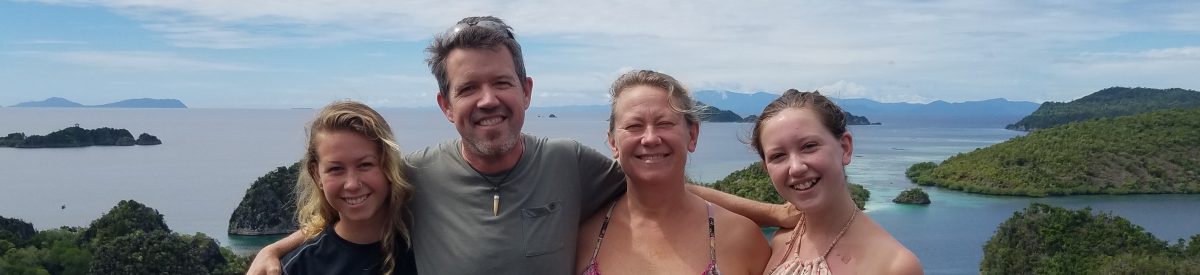
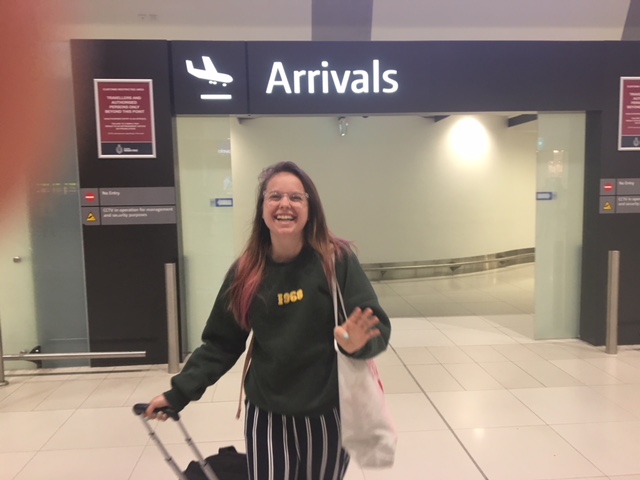
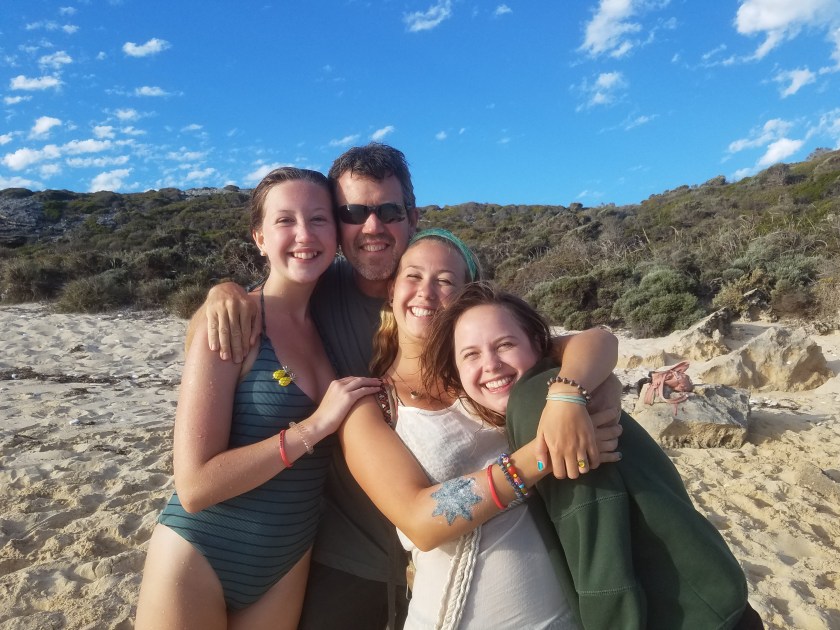
We spent a full four months in Australia, and for our final 10 days rented a lovely house on the Swan River in the Maylands, Perth neighborhood, with an amazing host who delivered fresh mangoes regularly. My 25 year old niece Sarah (sister Ingy’s oldest daughter) joined us from China, where she’s working at a school for the year. We had seven days of fun, adventure and sightseeing with her, amidst time spent successfully selling all of our camping gear and our big truck.
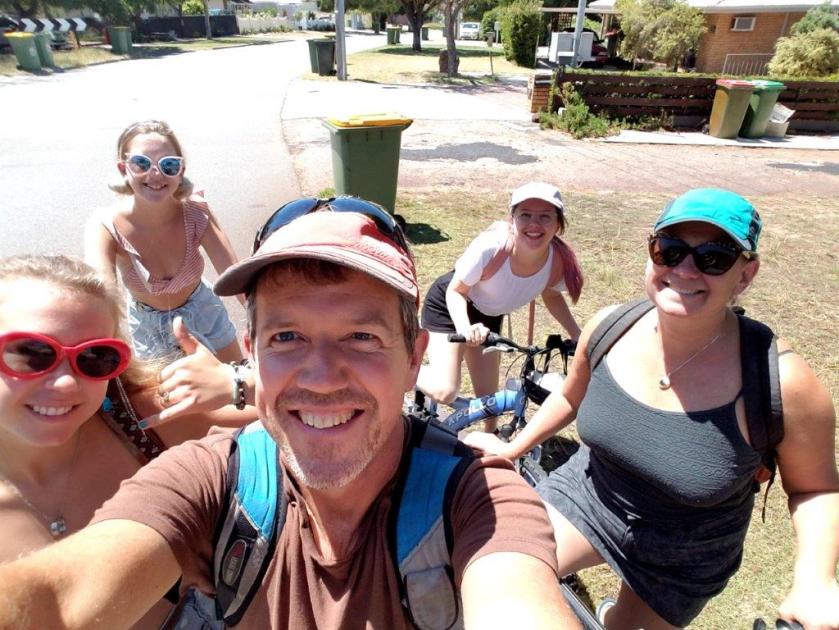
One day we cycled along the river to the downtown area, enjoying the King’s Park Botanical Garden and a Fringe Festival show. Perth has the third largest Fringe Festival in the world, with many performances in multiple locations every day for a month. We got to see one Diva show, where six cross-dressing males performed popular hits (mostly lip syncing though some actual singing, and a lot of good dancing, acting, costumes and makeup).
Dancing Queens
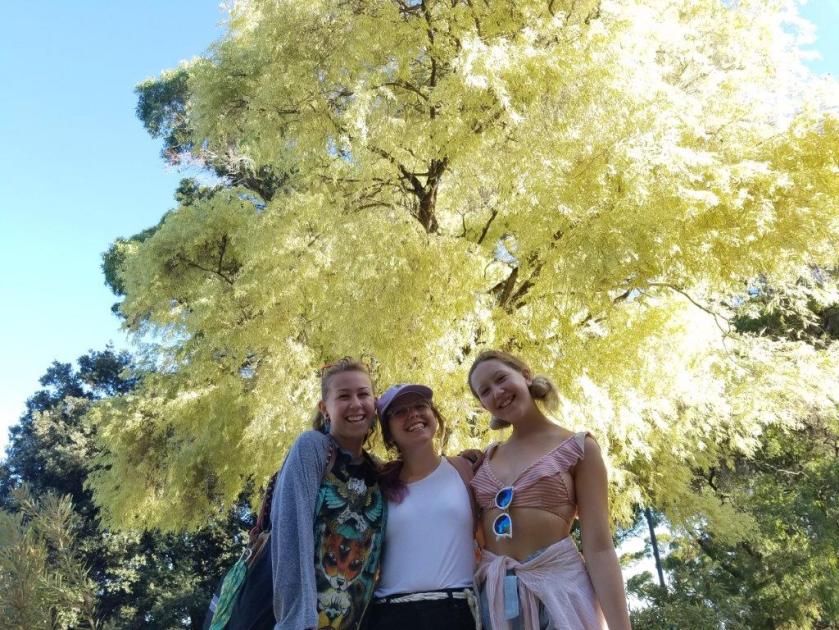
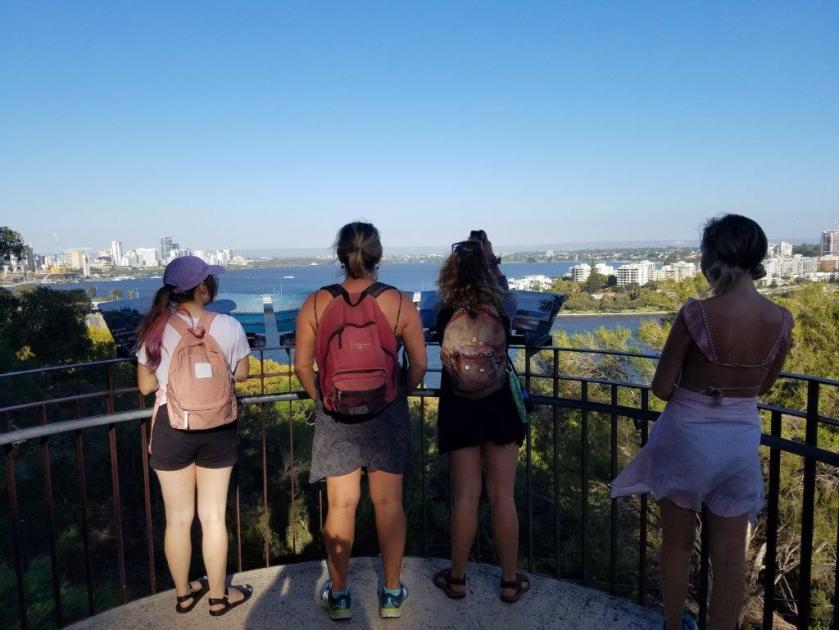
Mottlecah – eucalyptus


While in Perth, we visited Rottnest Island (inaptly named by a dutch sailor who thought the quokkas he saw were rats), where we biked, snorkeled and cavorted on the beautiful car-free island. It reminded us of Maine islands, including the annual Peaks to Portland swim race; the day we ferried to Rottnest there was a 20 km(!) swim, with 3,000 swimmers competing individually or in teams, each accompanied by a kayak guide, with larger boats and helicopters monitoring for sharks. A local told me of one man doing the butterfly stroke the entire way who hesitated briefly to turn on his electronic shark deterrent when he was warned a shark was nearby. These are tough nutters! The race has occurred for nearly 30 years, and the only deaths have occurred from heart attacks (and none in the past several years since more rigorous health screenings have been implemented).
The adorable quokkas (almost exclusively found on Rottnest island) are little docile, sweet marsupials that look like a wallaby crossed with a gerbil. One quite photogenic one was keen on staying by our picnic site to catch crumbs and enjoy a good scritchin’ behind the ears.
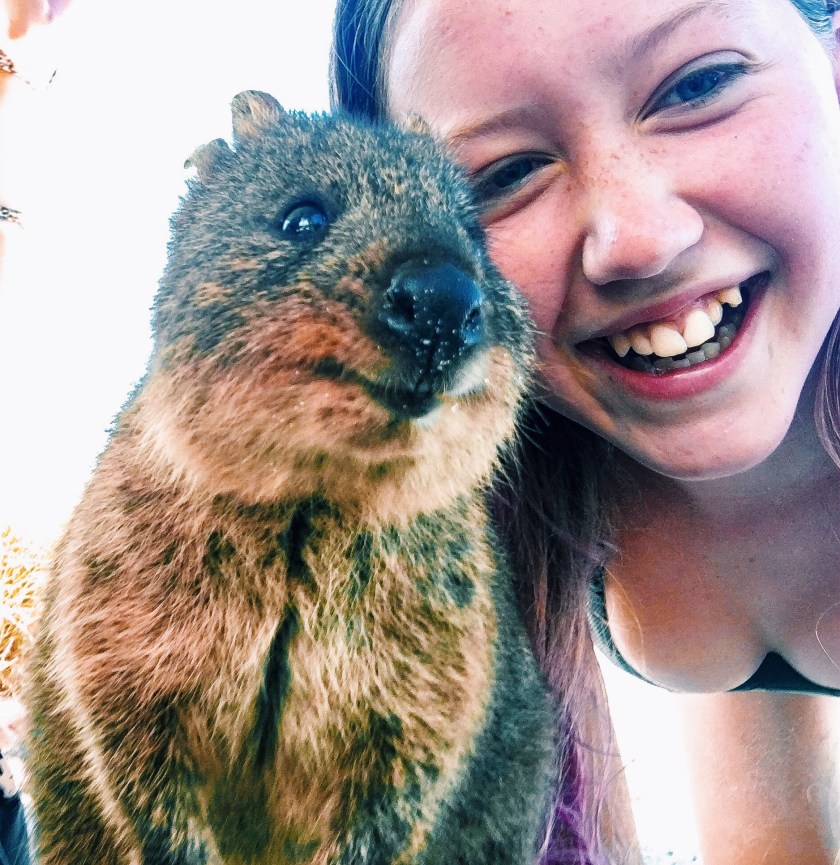
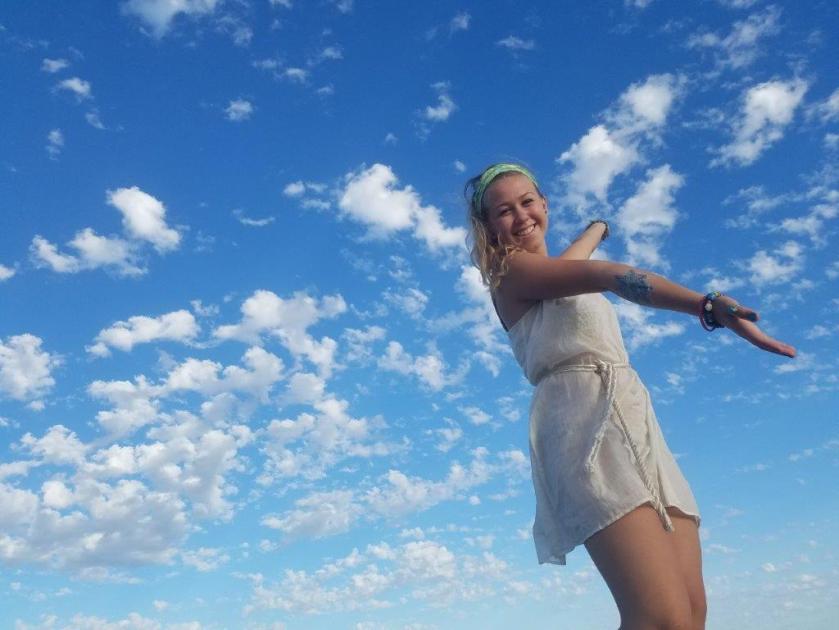
Helen yogi-ing


Another day we visited Penguin Island where about 1,200 Blue/Fairy/Little Penguins (different names for the same bird) reside. They are shy animals, so we only saw the 10 rehabilitating ones in the Discovery Center where we watched a feeding. The blue penguins mate until one dies or unless the female doesn’t produce eggs, upon which a replacement is found. We did learn of one exception at the Penguin Center; a couple partnered for 10 years who annually prepare their nest, brood, and attempt to lay eggs. They are never successful but they continue to try, and often foster orphaned penguins. The reason they have never been successful laying their own eggs is because they are both male, though devoted life partners.

In Perth Ella cashed in on her birthday gift, which was a tattoo on her forearm of a carpet sea star. This represented the ones we found at Yuragir National Park north of Sydney, a special place and time for Ella.
Carpet Seastar/Simp, and Ella’s forearm tattoo


As I write this draft we are en route to Bali, Indonesia. We’re feeling lucky to be on board, as the booking site “CheapOair” messed up and made us all Mr. Douglas Strout. We couldn’t get it fixed via the phone, but the AsiaAir personnel were patient and gracious and got our gender and names correct for international boarding.
It’s hard to believe our four months in Australia are up. I was thinking this morning about some of the “little things” that are different between Australia (as well as New Zealand) and the United States.
Here are a few random differences between the USA, and Australia and New Zealand:
Aussies and Kiwis (New Zealanders) are serious about their coffee, and do it well. We never saw coffee pre-made sitting on a burner or in a decanter, and one coffee expert informed us they call Starbucks “Charbucks”. The coffee is always made barista style, and takes a few minutes to make. If one orders a sandwich or a muffin, it is toasted and nicely presented on a glass plate with silverware, not wrapped in plastic taken from a shelf. This means waiting a few minutes, something Americans are not great at. Even the McCafes at McDonald’s serve barista made coffee, delivered to your table with your warmed goodie. At most restaurants it is common to not have a waitor come to your table; instead the customer orders food from the counter. Tipping is not customary, which may account for generally less attentive service than we are used to in America. Their food is more expensive (both in markets and restaurants), though their wages are much better. The Australian minimum wage, for instance, is $18.29/hour, or USD $14.
There are always public toilets in Australian and New Zealand towns, and they are typically very clearly marked, quite clean, and with toilet paper! Other than highway rest stops, I can’t recall a single public toilet in Maine, USA.
Australia does not make smoking look sexy. All of their cigarette packages have very graphic cancer images caused by smoking. There’s no cool Marlborough Man here…. They also make it very cost prohibitive, with a package of 20 cigarettes costing $30 (nearly two hours worth of minimum wage, and the equivalent of $24 USD). Alcohol is similarly highly taxed; a six-pack of good beer costs about $25 (or $19 USD). Even though so much good wine is produced in Australia and New Zealand, the same wine is usually more expensive than in the USA.

No one has to take their shoes off in Australia or New Zealand for airport clearance, and the process is much quicker. Australia also responded immediately and strongly to a mass shooting in 1996 when 35 people were killed and 23 injured by one man. The commonwealth and all states and territories implemented a buy-back program, as well as licensing and regulations of semi-automatic rifles, semi-automatic shotguns and pump-action shotguns. There have been no mass shootings since. Something to aspire to, America.
“Roundabouts”, or rotaries as we call them in the US, are abundant in Oz and New Zealand. They work brilliantly!! No waiting at a red light when there’s no other traffic coming, and no 4-way stop signs resulting in confusion about whose turn is next. Of course they do drive on the wrong (left) side of the road, and the steering wheel is on the right hand side. Even after six months I am still apt to go to the left door to drive. Fortunately we’ve made just a few uneventful driving-on-the-wrong-side-of-the-road mistakes.
Aussies and Kiwis have their priorities straight when it comes to time off, and businesses being open. Grocery stores often close by 6 or 7pm, and many aren’t open on Sundays. Shops generally close by 5pm weekdays and often 4pm Saturdays. There are multiple employees in pharmacies, so I always had more than enough help finding products and getting questions answered. Getting a prescription filled takes nearly no time; this is likely due to good staffing, and far fewer prescriptions and over the counter medications being consumed than in the US.
So we all know Aussies talk funny. I mean, who can say, “Crikey!” with a straight face?? Here are some legit expressions we heard that made us smile:
“Wacko!” – meaning “Great! Awesome! Cool!”. We’ve adopted this one.
“Fair dinkum” – meaning “Seriously?” as well as “Fair play.”
“Arvo” – afternoon
“Avo” – avocados
“Recepto” – reception (but why?? It doesn’t save any syllables!)
“Tinnies” – cans of beer
“Stubbies” – bottles of beer
“Pressie”- present
“Eskie” – cooler
“Toastie” – toasted sandwich
“Brekkie” – breakfast
“Grandies” – grandchildren
“G’day” (east coast)
“How y’goin’” (west coast) – meaning “How are you?”
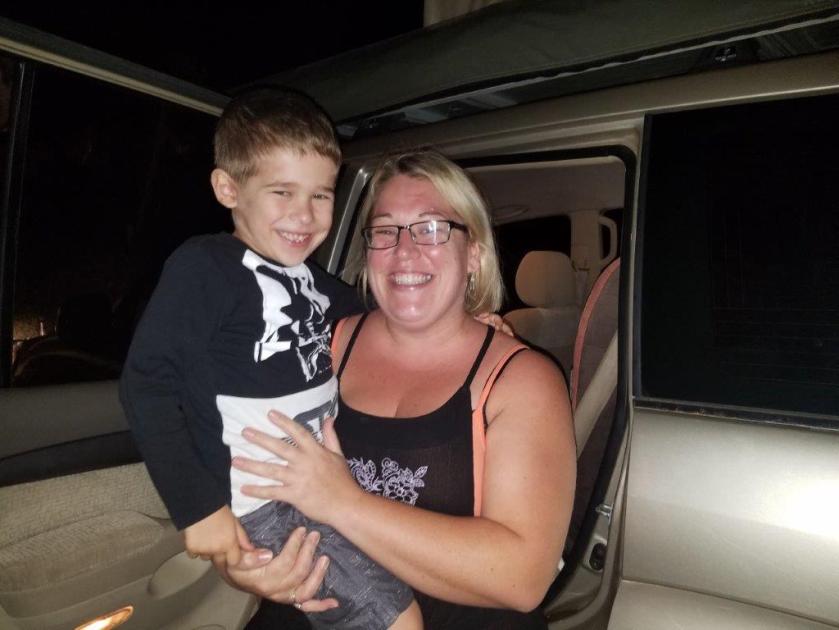
Sometimes it’s just fun to listen to, like when four year old Alex (his Mum bought our truck) informed us he needed to “use the loo to go wee.” Let’s face it, it sounds cuter than “going to the bathroom.”
We’ll miss this massive, unique, fascinating, diverse country called Australia. As Ella says, it’s “one big fossil”. The people have been so welcoming, the weather lovely, hot and dry, the creatures unique and wacky, and the adventures memorable.
A final shout out of gratitude to our amazing hosts in Australia!
- Ariel, Don and Christine Norris
- Annie Kiehn and Peter Coe
- Julie and Graeme Gale, and her mother Jean Pike
- Fran and Greg Hausfeld
- Airbnb host Anton Tsavourelos
And to our brilliant hosts in New Zealand!
- Andy, Tish, Ellie and Cameron Riley (and Tish’s parents George and Jean, and sister Karen and brother-in-law Wayne)
- Stephanie and Joelee Lee
- Raylene, Nic, Erin and Megan Wood
- Suzanne and Colin Mikkelson
- Airbnb hosts Gina and Tony Whyman
And countless other Airbnb hosts who have been fabulous, welcoming, and helpful.
We feel blessed to have made these wonderful friends who we hope to host in Maine.
Thank you New Zealand and Australia!!!
Next, Bali, Indonesia!
Doug’s email to his family about our last leg of Australia:
March 1, 2018
“Hi all,
Big day today. We’re strapped on board an Air Asia flight right now bound for Bali. These 10 days since my last email have been a bit of a whirlwind, and all successful. The big relief was selling our Prado, just last night, to a woman and her almost 5 year old son. She’s (they’re both, really) thrilled, and plans to drive it north to Broome this Easter, where they’ll live for a while and take 4WD expeditions up to the Kimberlies and the Gibb River track, 2 big adventures we’d love to come back and do someday. If curious, this scheme of buying a car and then selling it again (vs renting) worked well for us. We bought it for $18,900 (AUD) back in October, put about $3500 into new wheels and repairs (a clutch and replacing the hail damaged hood), drove it about 20K kilometers across Australia, then sold it for $16,500 after receiving about $4K from the insurance company for the hail damage. So that’s about $2K AUD it ended up costing us, plus fuel and tolls (and a bit on insurance and a towing service) for the use of a nice 4WD truck for 4 months. Pretty much all the ancillary items we bought to go along with our travel adventure (solar panels, air compressor, fridge, sleeping bags, etc.) we sold on Gumtree (the local Craigslist equivalent) for about 60% of what we bought them for. Other gear we mailed home to ourselves, or to Chris Zimmerman in Germany (stuff we’ll need for the last (Swiss Alps) leg of our trip next July) and now we’re down to just the 4 backpacks (weighing between 20 and 30lbs each) and our 4, not overstuffed daypacks. Wow. We’re practically floating. The contrast from our fully loaded SUV these last months is startling and feels great.
And in between all these transition logistics, this last stretch in Perth was a lot of fun. We stayed at a lovely Airbnb in Maylands, overlooking mango trees down to the Swan River. We were there for 10 days, our longest stretch in a single location since leaving Maine back in July. Anton, our host, lived a few doors down the road and quickly became a new friend. He lent us all bikes to ride along the river and into the city, gave us fresh picked mangos each day and even came one morning and cooked us a Greek pancake breakfast. An interesting guy, Anton started a trade apprenticeship in plumbing at age 12, back on Lesbos. At 18, he jumped ship as an illegal alien in Perth and quickly transitioned from plumbing to a more lucrative tiling business as he struggled to learn English. Within a few years he was importing tiles and had several employees. His illegal status was eventually solved by a friend of a friend (a member of the Australian parliament) who managed to pull some strings and get him his Australian citizenship. He’s now quite wealthy, and stays busy managing his properties and selling mangos (and other fruit) from his orchards at local farmers markets. Anyway, we all bonded over several social gatherings and we now have a solid friend and contact should any of us return to Perth.
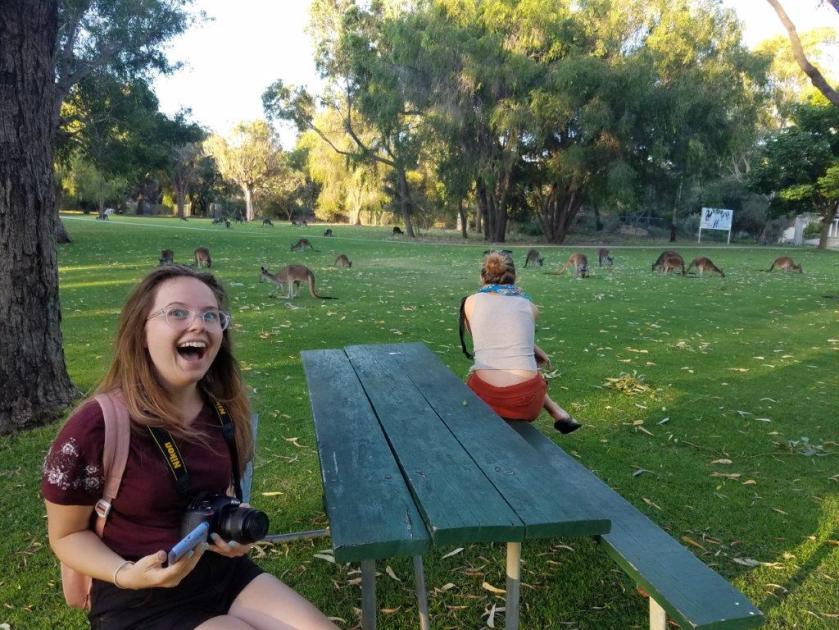
What made this last stretch most special was a great visit from Anna’s niece Sarah, sister Ingrid’s daughter. Sarah at age 25 is spending a year in China, working at a private school that helps wealthy kids bone up on their English and other skills in preparation for university in the states. She flew down to Perth, via a short visit to Malaysia, joining us the day after our arrival and staying for 8 days. Our Airbnb was plenty big, with 4 bedrooms, and the 5 of us had a blast together, exploring the city and taking some Prado excursions to check out several area attractions together. So much fun to see kangaroos and koalas with Sarah, along with parrots and cockatoos and even quokkas out on Rottnest, cutie little hopping marsupials that have become quite tame on the island. Our day on Rottnest was big fun, riding bicycles around an island that doesn’t allow cars, stopping at different bays to swim and picnic (and for the girls to take quokka selfies!). Sarah had never snorkeled before so that was also brilliant, getting to see her gradually relax into the experience, then get excited at her glimpse into the incredible new underwater world of corals and fish.
And speaking of corals and fishes, let me briefly back up and mention a couple of highlights of our time spent on Cape Range National Park. This was after we left Shark Bay, several weeks ago now, and drove the 4 hours north to Exmouth, then another hour across and down the west side of Cape Range, another world heritage listed area located in the heart of the Ningaloo fringe reef. We spent 4 nights camping at the south end of the park near the edge of Yardie Creek, the mouth of a tidal river estuary. This is the park’s slow season, as the whale shark migration ended back in October (after the annual coral bloom that nourish the crustaceans that these magnificent filter feeders gorge on) and it is often hot this time of year with the threat of cyclones. The park and our camping area was mostly empty, but the weather was fine and dry, though windy in the afternoons. Each day we visited different bays with fine coral, fish and visibility. It was truly a world class experience and easily the best snorkeling Anna and the girls have ever done. We saw lots of turtles, big rays, and both white and black tipped reef sharks. The coral was colorful and appeared in excellent health (such a relief as we hear of bleaching on the barrier reef and the statistic that about one half of all the world’s oceans have now died in just the last 30 years).
One evening we attended an outdoor turtle lecture put on by a couple of female rangers, then the 10 or so of us walked along a beach looking for egg laying female greens and hawksbills. It was dark and we weren’t using flashlights but the idea was to look for large dark shapes emerging from the water. Somehow, one of the rangers spotted a faint set of hatchling turtle tracks and we gathered round to watch a baby turtle (probably a green) emerge from the sand and waddle the 50 or so yards down the water. The ranger then used a flashlight with a red filter to illuminate the same spot, where we collectively gasped at an eruption of about 25 baby sea turtles, all clawing their way up through the sand, then tottering their way between our legs and down into the gentle surf. It was magic. We were all blown away at just how precious and vulnerable those babies seemed, including the 2 rangers, who said it was only the 2nd time in a year they’d actually witnessed a hatch. On another note, later that evening while driving the 45 minutes back south to Yardie Creek we estimated seeing about 800 kangaroos, mostly Euros and some black flanked rock wallabies. This estimate was based on counting how many we’d see in a minute, then averaging and extrapolating. Amazing, and not sure if the bush out to either side of the road also had that many or if they were for some reason concentrated near and on the road. Crazy to realize we’ve literally seen 1000s of kangaroos now since arriving in Australia 4 months ago.
The other noteworthy experience we had on Cape Range was rescuing a group of German tourists who bogged their Landcruiser in Yardie Creek. On our last evening, just as Anna was putting the finishing touches on our camp dinner, a woman appeared out of the dusk appealing for help, as her vehicle was stranded and the tide was beginning to rise. Turns out the 2 sisters and a husband had bogged crossing the river that morning and had been stuck all day. The first high tide was a small one, only reaching half way up the side of their vehicle, but the 2nd, evening high tide was scheduled to be much higher and would certainly result in the death of their expensive rental. There was another group of 3 young people there offering to help, but the car was deep in the sand, almost down to its underside, and no way could it be pushed. Shoveling water saturated sand away from the tires didn’t help as each shovel full would immediately refill from the side. The big fear was if they tried spinning their wheels any further they would simply dig deeper and the weight of the vehicle would soon rest on the undercarriage, ending any remaining leverage and hope of escape. I took all this in as I drove our truck to the water’s edge, illuminating the surreal scene with my headlights, the vehicle deeply bogged in shallow water about 50 meters from shore.
I really thought it looked pretty hopeless. There was no way we could push it out and even using my truck’s winch it seemed the bogged vehicle would be a heavier anchor than ours. We tried anyway, and managed to just reach them with our 50 meter winch cable fully extended. Then sure enough, as I engaged the winch the tension simply caused our Prado to drag towards the water. They were truly stuck.
Out on the river, with the bogged Landcruiser illuminated in our flood lights, I tried a couple of shovels of sand and confirmed that couldn’t help. The tires, from what I could see of them, seemed quite hard and I asked how many psi they still had. I was told that a garage had lowered them to 20 psi that morning, as they knew they would be crossing the river. I explained that tires could actually be lowered all the way down to about 7 or 8 psi in a pinch, so got my tire deflation tool, only to discover they were still inflated to around 30. We used the tool to deflate the front 2 tires, despite the nozzles being underwater, but the back 2 tires were both underwater and in soupy sand so my tool wouldn’t attach. I then simply used a flat head screwdriver to release air, blind, and not knowing how much inflation remained. It was tricky. I needed to get the tires really low, almost flat, to maximize their width and traction on the sand, but too low and they’d be flat and not function. After a few minutes, Anna and I both decided we’d released about the right amount, near as we could tell, in each rear tire. Then the German group asked if I’d attempt to drive the car, as they’d had minimal experience driving on sand. The group the 3 Germans, the 3 other young people (2 Swiss and a German) Ella and Helen all got ready to push and I got in the driver’s seat, ready to reverse the vehicle back up out of the sand and towards shore. Anna was with the Prado, controlling the winch. When the winch engaged our headlights dimmed, the signal for everyone to start pushing and for me to reverse. And just like that, the Landcruiser plowed up out of the sand and onto a sandbar half way to shore. We all cheered and hugged, then disentangled the winch cable from around the wheels (turns out I should have just detached the cable (a super slow tool) from the bogged vehicle before we attempted driving it out), then I was able to drive the Landcruiser though a last stretch of water and up onto dry land. I checked and the back tires were practically flat, down to about 5 psi, but had just enough inflation to keep off their rims.
Both groups of travelers camped next to us that night and we had a bit of a party, then the next morning I was able to re-inflate the Landcruiser’s tires using our compressor. Later I was thinking, Steve, how that good deed was retribution for the (how many?) times we stalled out our swag wagon in streams driving up to Cape Tribulation above Cairns. It got to be routine 30 years ago, the 4 of us (with Nigel and Rob) arriving at another tidal crossing, spraying our spark plugs with WD40, putting a plastic tarp over the front of the hood then driving into to water, inevitably stalling somewhere out in the deepest middle area, then waiting till the next vehicle happened along the track, always a capable 4WD that made quick work of hauling us out using our marine line taken off the Soren Larsen. I was thrilled, and had really stressed at the enormity of the situation and the stakes involved (the fate of a $70K 2017 Landcruiser), though it was also exciting and a crazy kind of adventure, particularly as the monetary risk wasn’t ours. On one further side note from that evening, I had to walk/run back to our campsite from the creek twice that evening (about 1K) and each time saw cool creatures in my flashlight beam. On the 2nd trip I saw a scorpion on the sandy trail, the first I’d seen since getting to Australia. I was only a couple of minutes from our site and grabbed a Tupperware container, thinking I could catch the scorpion for later inspection. It had disappeared by the time I returned, but a bit further down the trail there was a small snake crossing the trail, only about a foot long. I caught it in the container, then later when the crisis was over and we were all back at camp, Ella identified the snake as a young stimson python. Beautiful and completely docile, it was handled by many people that night, weaving itself though our fingers, before we released it back on the trail. That may have been the craziest night of our travels so far, and so glad it all turned out okay in the end.
The stewardess just asked me to close my tray table in preparation for landing. I’ve been listening to various announcements from the pilot in Indonesian and still can’t quite believe we’ve gotten to this next phase of our trip. Look forward to filling you all in on what we experience upon landing, and I guess the folks will read this email while visiting with us in a few days. Our plan, incidentally, is to fly to Komodo tomorrow. There we will take a private boat for 3 days out into the national park, another world heritage area and home of the (gulp) fearsome Komodo dragon. Love you all and love, love,
Doug”
 Strout Family Year of Travel