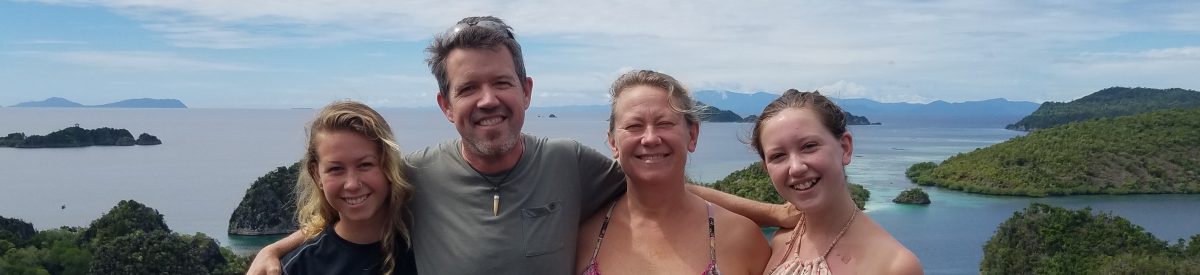
Let me just say, it’s tricky completing a blog post. We usually do not have internet and when we do, it tends to be frustratingly slow. Helen and I share a laptop, so anything I work on is in choppy segments it seems. Nonetheless, we are fully enjoying our big trip, and are in awe of Australia, with or without wifi!
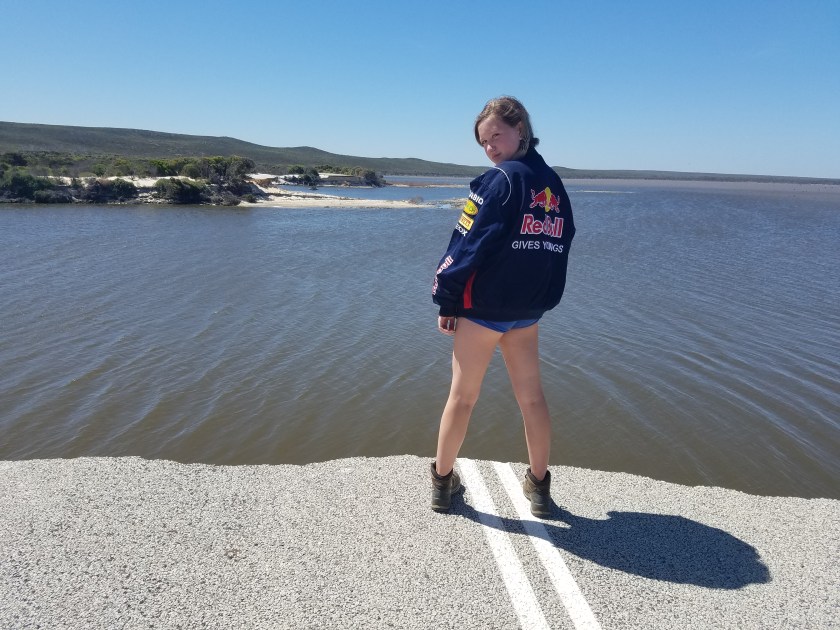
We left the windy Mt Arid National Park and headed west to the lush Margaret River Valley, stopping in Hopetoun and Albany on the way. In Hopetoun we hiked Barren Mountain in Fitzgerald River National Park. It turns out this is one of the largest and most botanically significant national parks in Australia, where nearly 20 percent of WA’s flora species are found- many of which occur only within its boundaries.

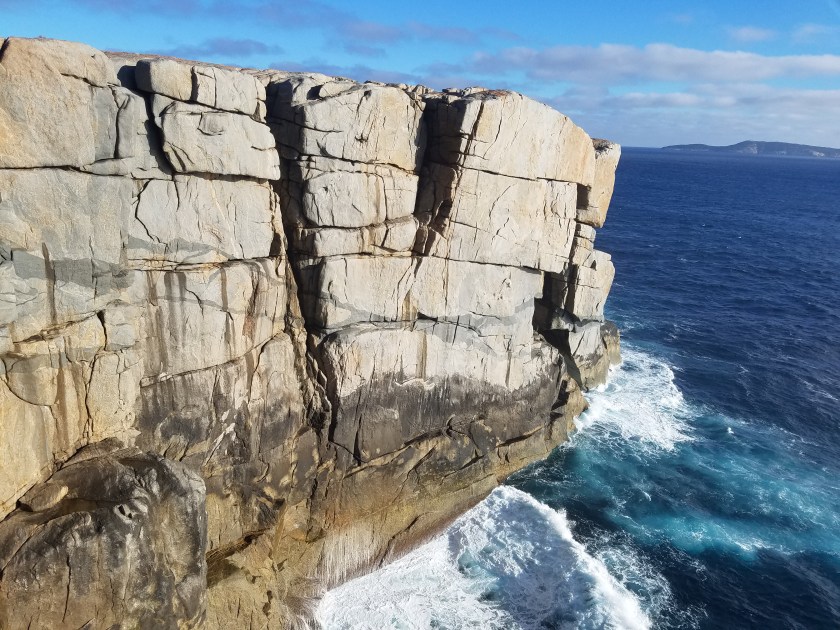
13 second video of mesmerizing waves in Albany.
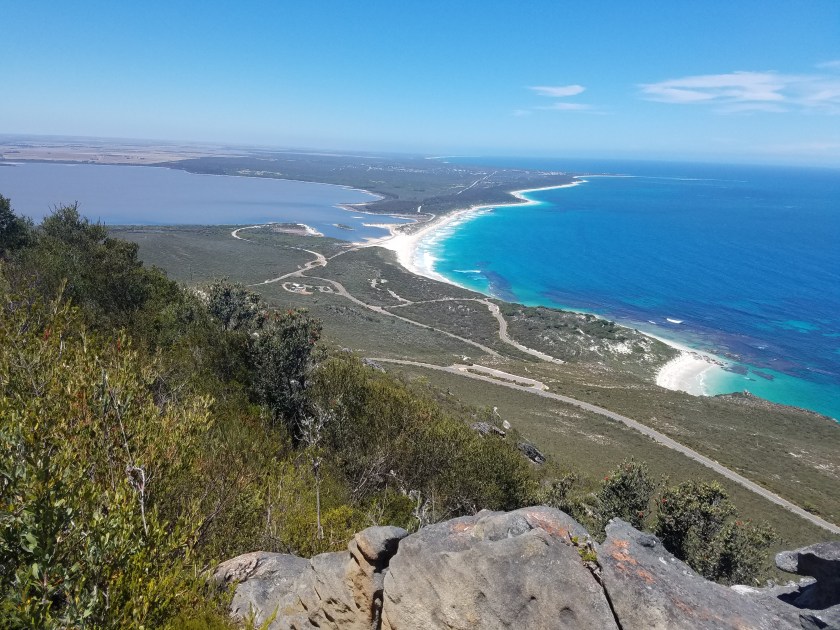
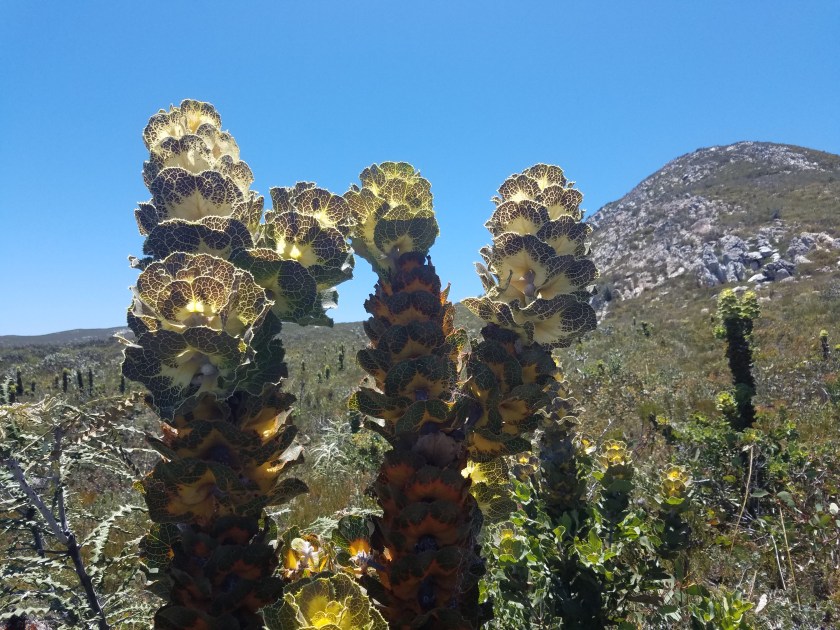
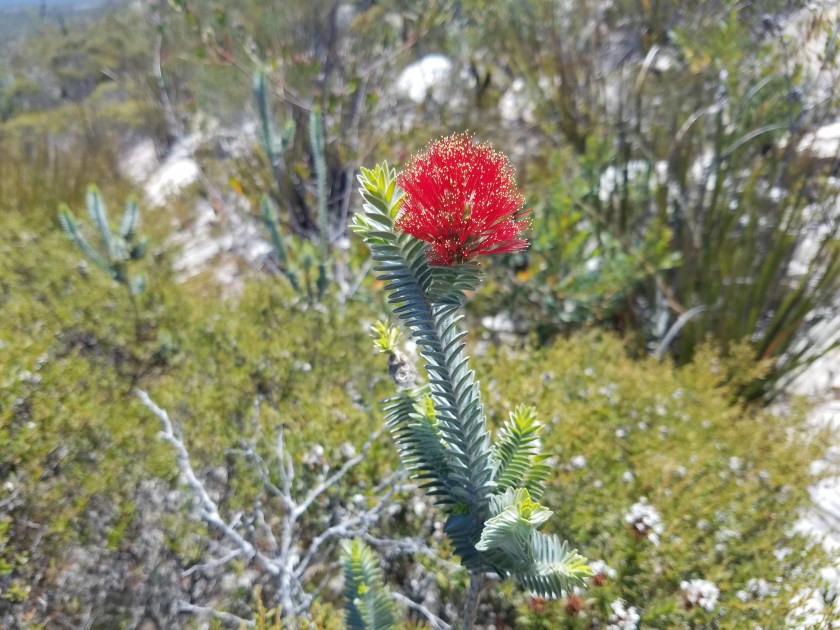
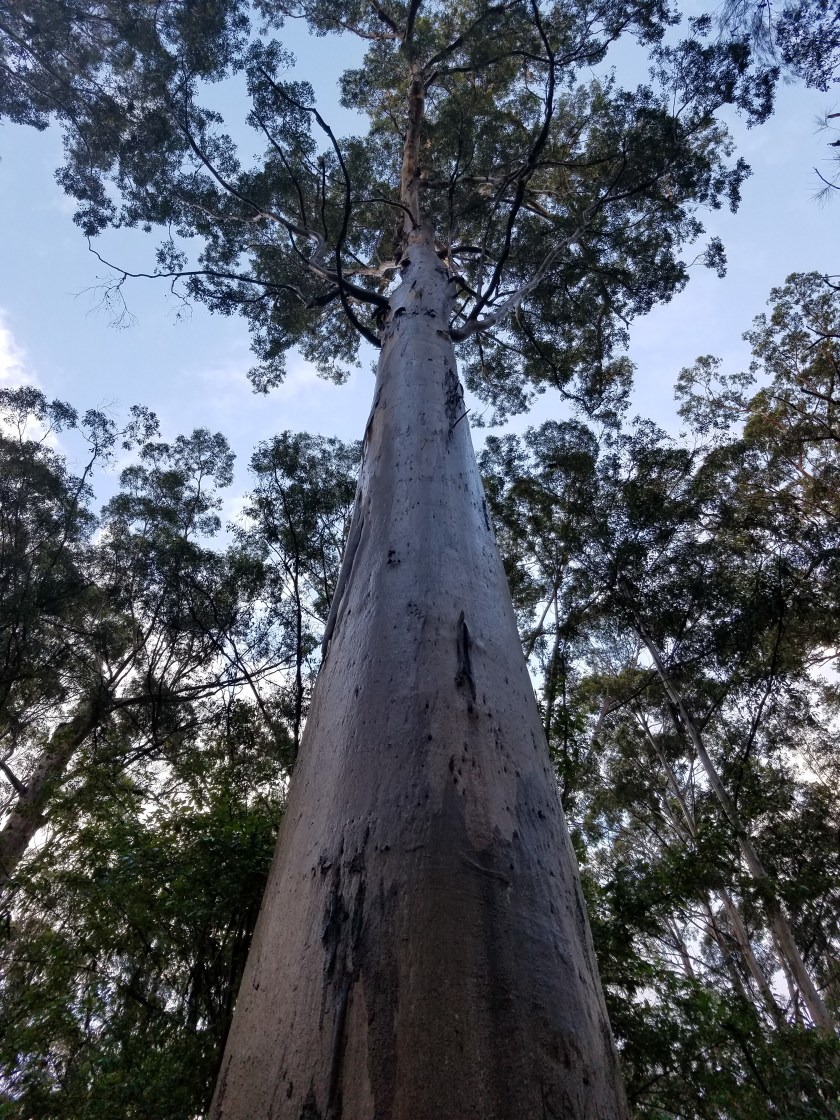
We continued on to Pemberton in the Margaret River Valley, famous for its wine, olives, “avos” (avocados), and surfing. It’s unique Mediterranean climate has more biodiversity per square kilometre than the whole United Kingdom. It was refreshing to see some fresh water and green pastures after so much dry desert; we even had our first day of rain! The karri forests there reminded me a bit of New England, with some exceptions (such as kangaroos instead of deer, the smell of peppermint and eucalyptus instead of pine…you know….)
7 second video of kangaroos hopping through our yard
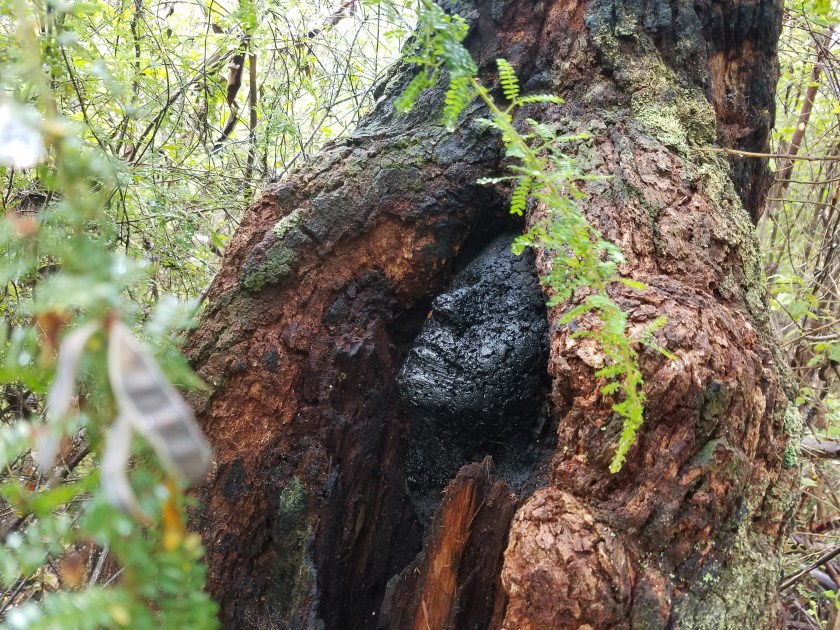
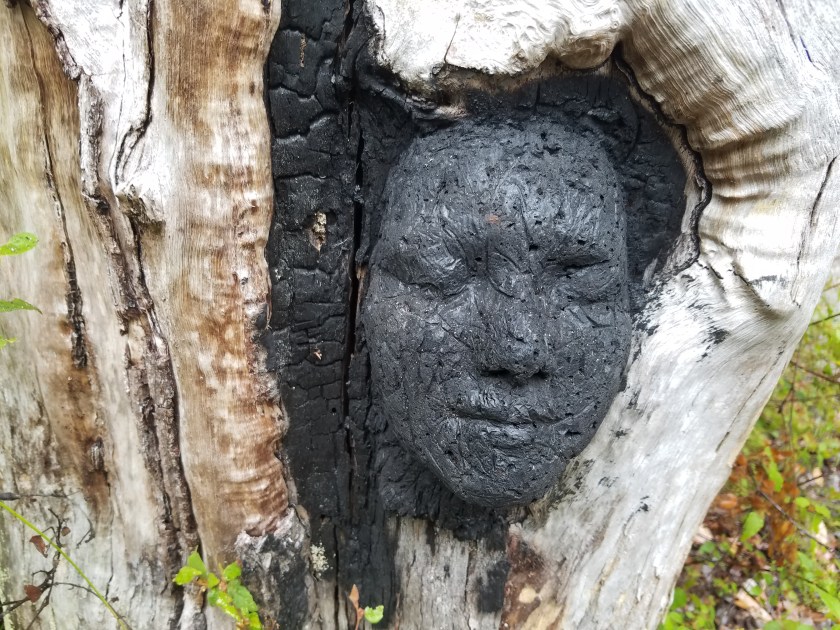
We enjoyed the magical, mysterious faces sculpted into burnt trees in the outdoor sculpture exhibit “Understory” in Northcliffe.
“Understory” sculpture photos by Helen


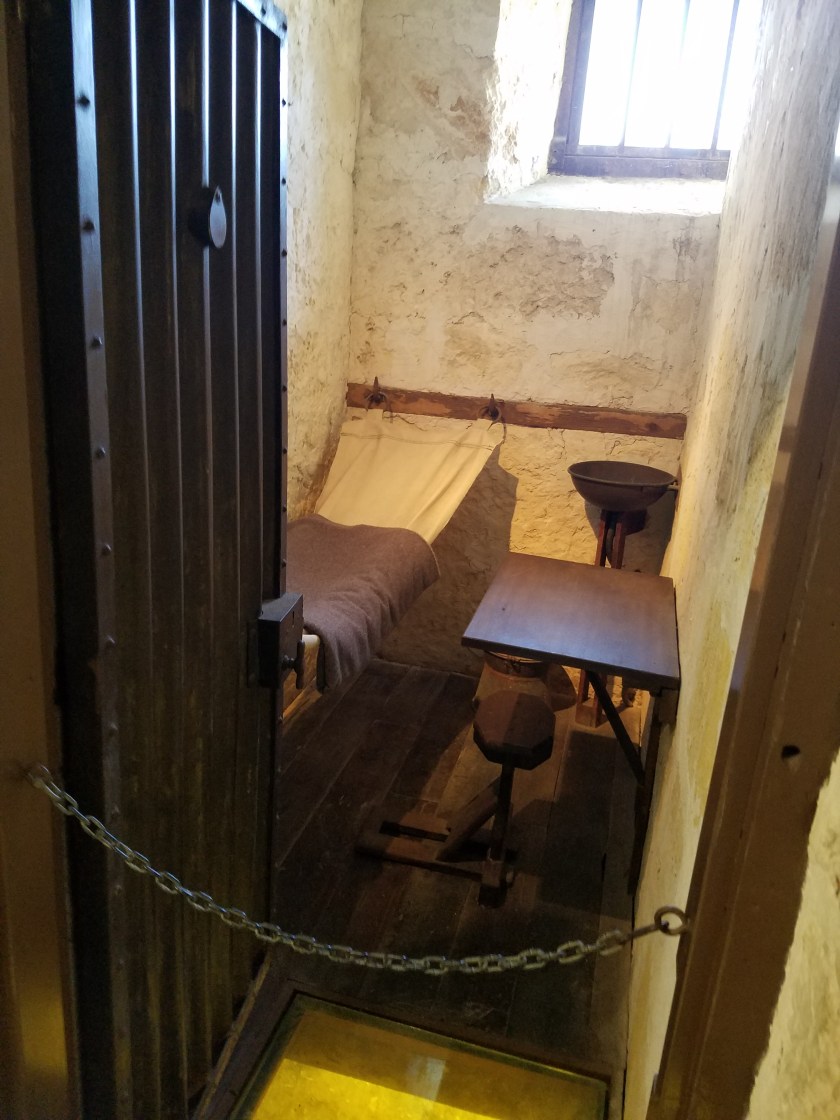
Perth was home for a few days while we had our hail-damaged truck assessed ($5,900 AUD worth of damage), and made plans for future legs of our trip. We stayed a few extra days in the cool coastal town of ‘Freo’ (Fremantle), where we enjoyed a great comedy show, an outdoor concert, local markets, and a tour of the Fremantle Prison. The prison was built by prisoners and remained full for the next 150 years, closing in 1991. Many of the early prisoners were sent from the United Kingdom for very small crimes such as stealing a loaf of bread, which could result in years of incarceration and labor. I can’t say I enjoyed the tour; it was a grim and unhappy place to be, especially with views of the flogging yard and gallows.
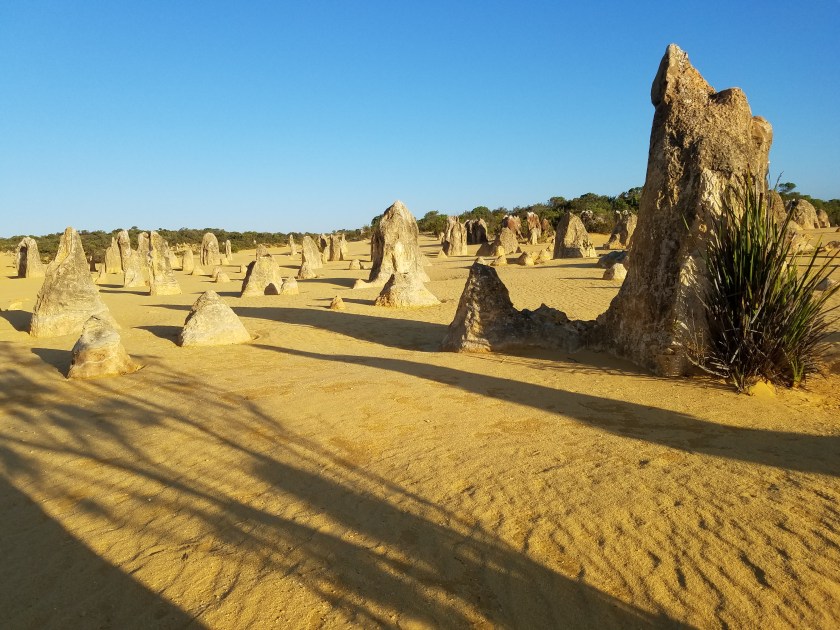
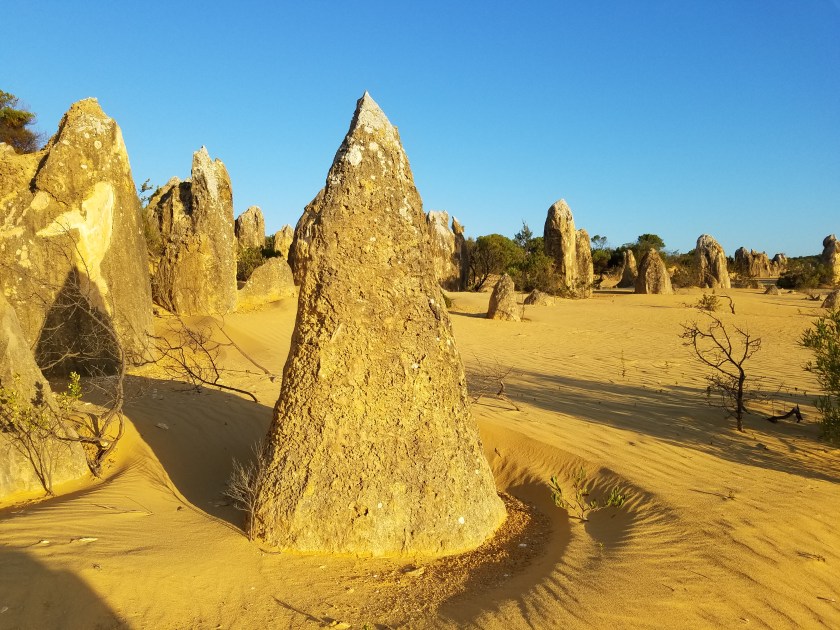
We purged ourselves of the prison vibes and headed to the spectacular and famed Pinnacles in Cervantes, north of Perth. These sandstone structures have withstood erosion leaving thousands of varied stone temples. The Aborigines thought the structures were human spirits.

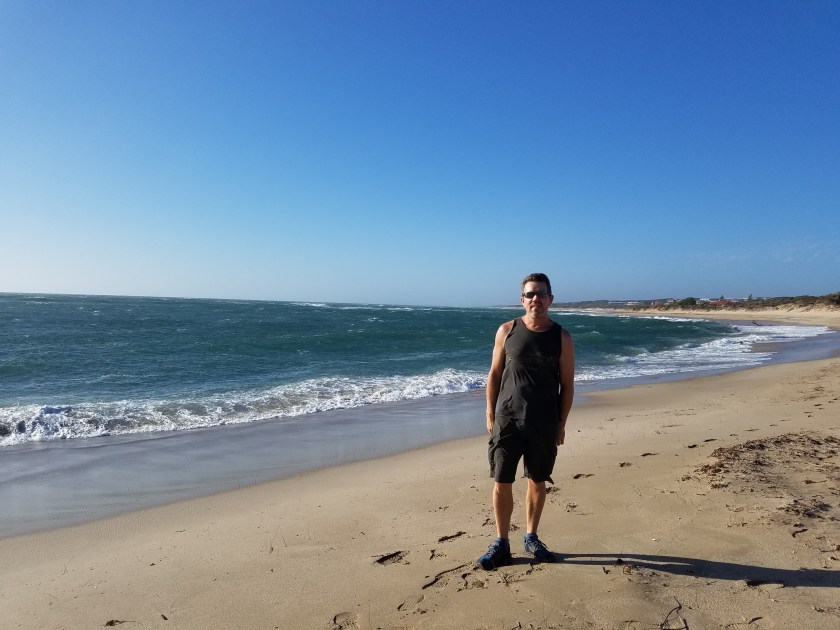
Working our way north to Kalbarri, we stopped in Dongara and “Gero” (Geraldton) to break up the 12 hour drive. Dongara was another rural, sleepy town with some pretty natural attractions, like most towns we’ve seen in Oz. Geraldton offered some great food and art. At the Geraldton Art Museum we enjoyed a virtual reality video of the true story of an Aboriginal man who witnessed an atomic bomb test in the outback 50 years ago. It wasn’t until 20 years later he learned it was a bomb; when he witnessed it he thought it was the great Spirit rising above the land, gifting his tribe with many instantly killed kangaroos. The tribe’s people got sick from eating the meat, but there are no known direct deaths.


Gero Butterflies


Aboriginal people have occupied Australia for at least 50,000 years. Wow. While there was significant contact between tribes, there was no contact or exchange of cultures or knowledge between Indigenous Australians and the rest of the world until 600 years ago. It wasn’t until the late 1700s that Europeans actually colonized parts of Australia. While in many areas good relations existed between settlers and Aboriginal people, tragically at least 3 out of 4 Indigenous Australians did not survive colonization due to killings, incarceration, forced removal from land, disease, restriction of movement and early attempts at forced assimilation. By 1911 laws were taken up in all states giving government total control over the lives of Indigenous Australians, dictating where they could live and be employed. Between 1910 and 1970 the government determined that children with non-Indigenous ancestry (part Indigenous, part European/Caucasian) should be taken from their families and raised in white institutions. This approach led to the forced removal of children, now known as the ‘stolen generations’, which not surprisingly had a pretty devastating effect on many children and families.
Australia’s current Aboriginal and Torres Strait Islander population has reached 669,900 (or 3 per cent of the total population). Up until 1970 there were still some Aborigines living completely off the land, honoring the sacred ways of their ancient ancestors passed down to them. We find it surprising that Americans don’t hear about and know more about this culture. Then again, we generally know very little about our own relatively young native American cultures, which have sadly suffered a similar plight as Australia’s Indigenous cultures.
Australia is vast. Apparently only about 5% of the land has even been surveyed, though new mines are continually being built to tap its abundant mineral resources. (Australia is the world’s leading producer of rutile, zircon, bauxite, iron ore and ilmenite, the second largest producer of alumina, gold, lithium, manganese ore, lead and zinc, the third largest producer of uranium, and the fourth largest of silver, nickel and black coal.)
Doug is our primary researcher, poring through books, blogs and brochures and making recommendations to the rest of us. We agreed to stop in the small town of Kalbarri where we celebrated Australia Day, or “Invasion Day” as some Aussies call it. It’s similar to our Columbus Day in that sense, but celebrated much like our Fourth of July. We had ourselves a little “barbie” and hit the fireworks show. The girls got to connect with some local teens for the night, but I got stung twice by a wasp and took it as my cue to head home after the show.
Australia Day in Kalbarri


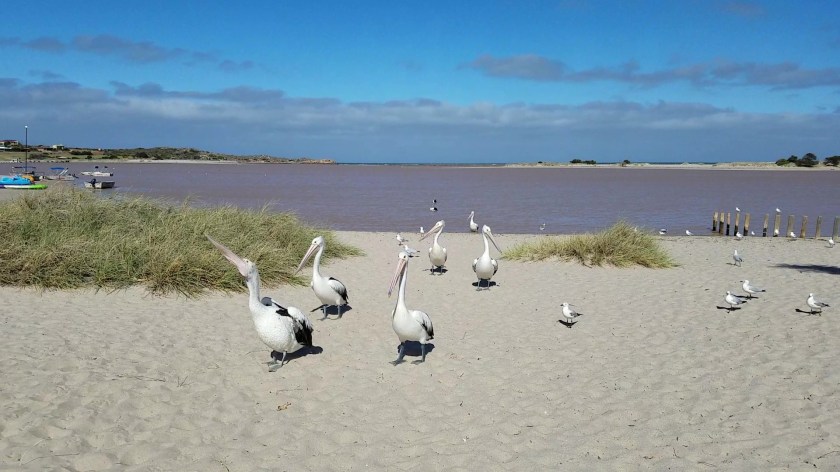
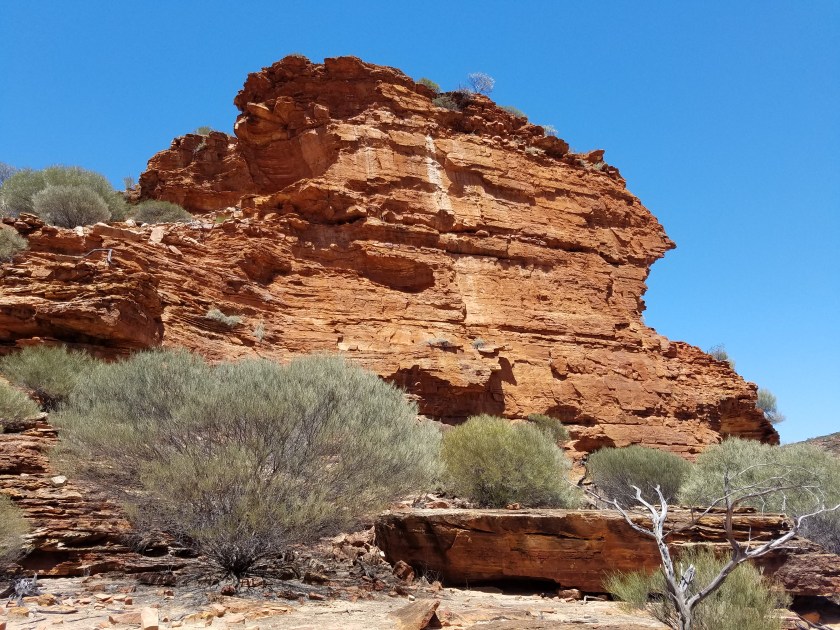
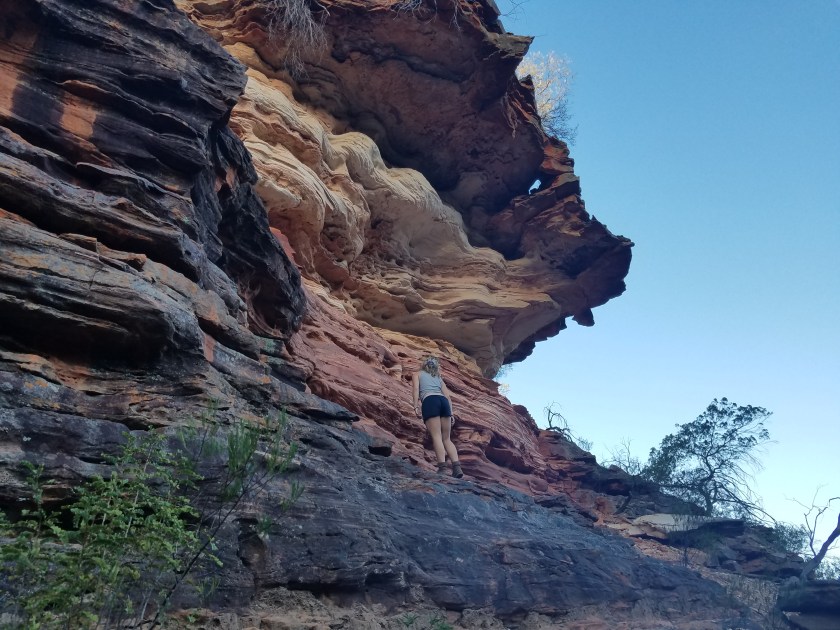
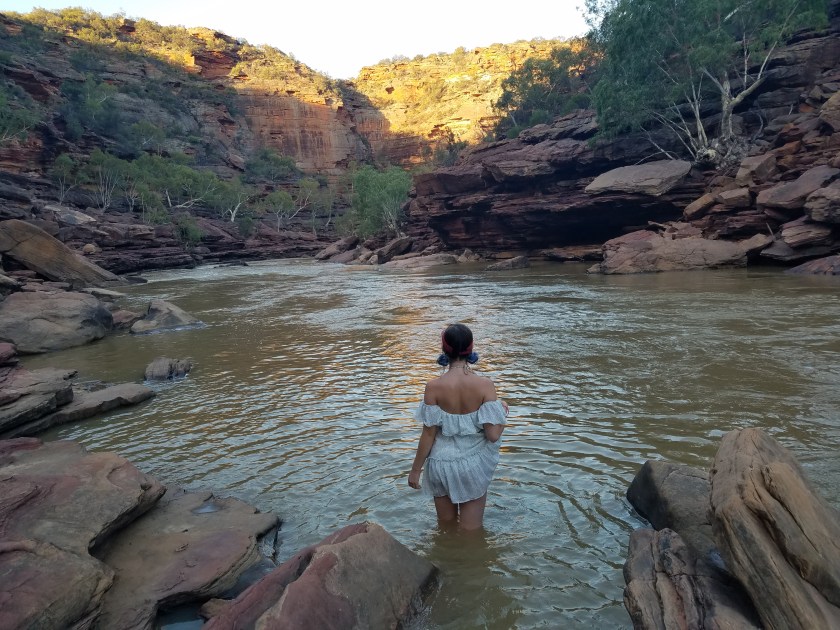
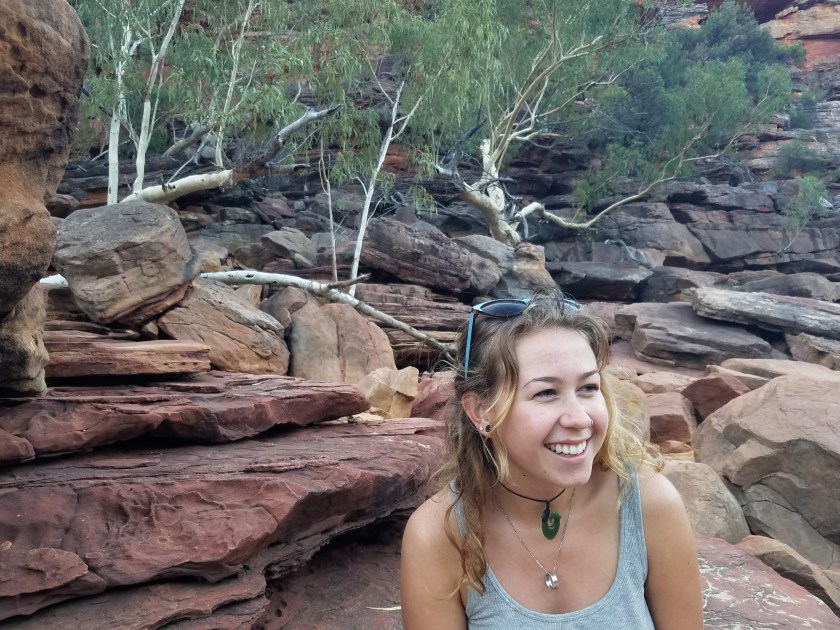
Doug and I hiked the Loop Trail at Kalbarri National Park, not realizing just how much hotter it would be in the gorge below us. Our 9km hike took 4.5 hours and was the hardest hike I’ve done due to the temperatures hitting 109F. If it weren’t for the Murchison River to cool off in I would have been another statistic of tourists who get rescued from heat exhaustion. It was a bit surreal with the dizzying heat, crunchy mud trail at parts (it had been flooded recently from a cyclone), and bright blue skies.
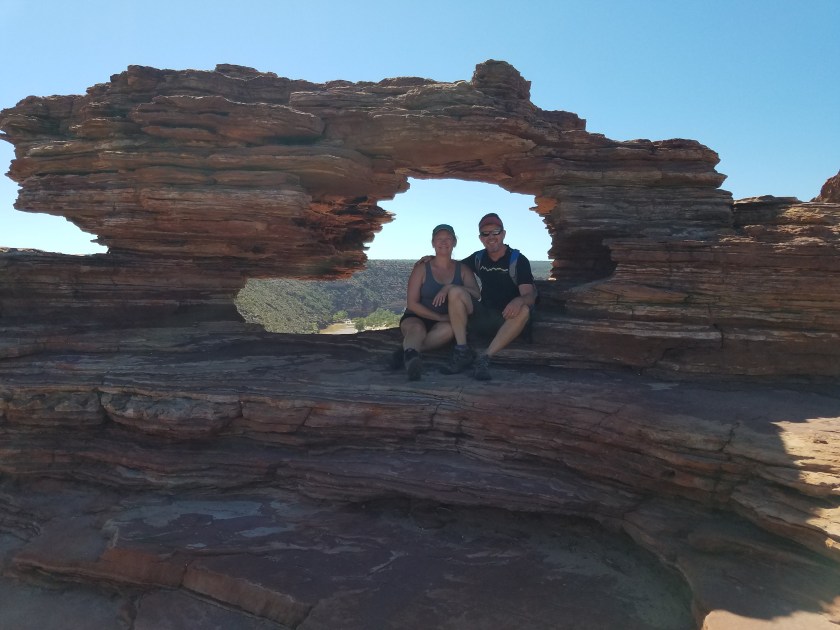
Loop Trail photos by Doug


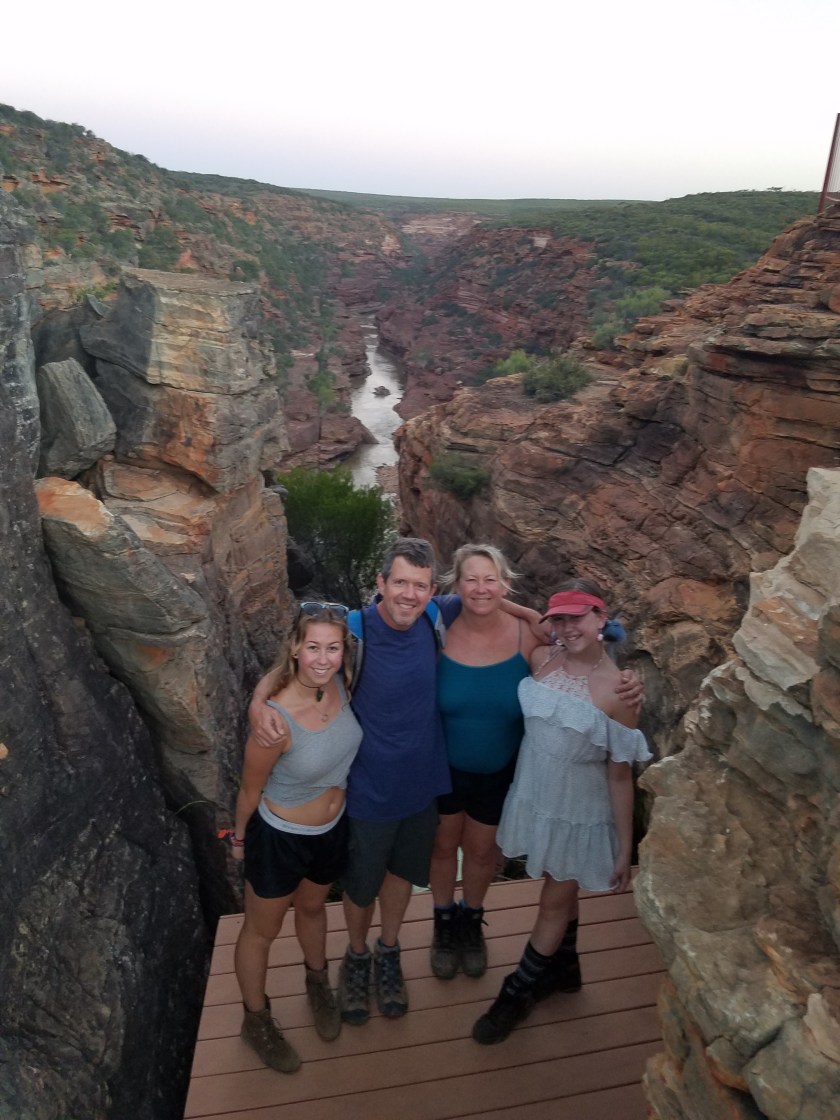
The smarter hike happened the next day, when we all did an early evening walk on the Z Bend trail into the gorge. Here, Ella spotted a Murchison Blind Snake which we would have mistaken for a worm had it not left a distinctive snake trail. (7 second video below)
Stay tuned for our next post featuring the oldest living creature on our planet, and sweet coverage of the Ningaloo fringe reef, Shark Bay and Cape Range National Park.
Cheers! Anna and family
Below is Doug’s recent email to his family, describing events in further detail:
“Hi Mom and Dad,
Wow. Ok, so I just checked and the last time I wrote was January 12th when we’d just left Cape Arid for the shelter of an Airbnb near Esperance. It’s now Feb 8th and I’d love to catch you all up on some fine adventures we’ve been having out here in Western Australia. For the first couple of weeks since my last email I’d been thinking it’d be easy to summarize events, as our time down south was fun but quiet and largely uneventful. Same with the week or so we then spent in Perth. This last stretch has been pretty freaking cool, however, and I’d say these last 5 days camping in Cape Range National Park have been among the most striking and special of all our 3 plus months here in Australia. We’re now in Exmouth, staying at a budget type lodge for 2 nights, happily out of the sun and gathering strength for our next adventure that begins tomorrow, a trip 700 km’s east to the gorges of Karijini National Park where we’ll stay 6 nights before driving back south to Perth and our final leg before joining you in Bali next month. Wahoo!
As I said, our time in the southwest corner of Australia was largely uneventful and easily summarized. It was beautiful, a temperate region covered largely with big Karri trees (some of the tallest in the world at around 90 meters) and dominated by big swaths of national parks and other reserve lands. Anna and I felt it would be great location to return to someday, maybe to explore from Perth on, say, a 2 week vacation. So much of the area is woods, interspersed with quaint small towns and wineries. And pretty vast. It’s easy to imagine a population of (supposedly extinct) Tasmanian tigers still living in the wild, a popular local theory and topic of fierce debate which researchers are currently attempting to settle. We stayed at several Airbnb’s in the towns of Hopetoun, Albany and Pemberton. It was coolish and even wet at times, a big change from the dry desert we’d mostly experienced since leaving the east coast, due in part to a cyclone that had hammered the coast further north, then worked its way inland and south to us as a decaying tropical depression. The hammering, in fact, was centered on the town of Broome, another 1000 km’s NE of us here in Exmouth. Two nights ago we spoke with 2 German sisters and a husband (after helping rescue their bogged vehicle from a tidal river crossing) who had finally escaped from Broome a day earlier after being trapped in town for 2 weeks with broken bridges and flooded roadways, making travel impossible.
By the time we made it to the southwest we were well into our allotted time here in Oz. None of us wanted to short change our opportunity to see some coast north of Perth, so hard decisions were made and we tore ourselves away from a really pretty idyllic scene and drove the 4 hours or so north to Perth. There we spent a week dealing with several logistics, including a Foxwing canopy repair and preparations to have our vehicle’s hood replaced on our return mid-month. Our 2nd Airbnb in Perth was in the coastal suburb of Fremantle, a now thriving area of historic homes and buildings, art galleries, breweries and coffee shops, dominated by an old prison built by convicts in the 1850s and operated until 1991. The home we stayed in was old and gorgeous, perched on the hill by the prison on the edge of town, and we spent our 4 days there wandering the streets, enjoying live music and several fine restaurants.
Then it was finally time to head north, and we arranged our first day to arrive just before sunset at a natural area a bit inland from the coast called the Pinnacles. There we walked among an improbable forest of 1 to 3 meter high rocky karsts, the result of some long ago shallow sea bed and subsequent erosion which left behind harder stone pillars, a grim army of ancestors (the aborigine interpretation) or evidence of an ancient civilization, as theorized by early European explorers. It was a magical, windswept place and for most of our visit we were the only humans present, sensing ghosts but seeing only emus and red kangaroos and the setting sun.
Our plan that night had been to drive on after dark to a camping area on the coast an hour north. By then, however, the wind was howling so we found an area with a bit of cell reception and connected with a beach efficiency unit and spent a comfortable night in Cervantes listening to the wind and surf from behind solid walls. Turns out this is a windy time of year and as we headed up the coast we were twice more thwarted from camping, choosing instead to stay at comfortable Airbnbs and lodges in the towns of Dongara, Kalbarri and Denham. Kalbarri was beautiful, a small coastal town set inside a national park, famous for both its sea cliffs and impressive river gorges. We spent a low key Australia Day there (January 26th), watching fireworks on the edge of the Murchison river. Ella and Helen connected with some local youth and had a happy, late night refining Aussie slang in the local skate park. Mildly interesting side note here. We’ve noticed on our travels through Australia (same actually in NZ) that every town, no matter how small, always has 2 features: a public bathroom, a playground and often a skate park. Nice for the tourists, and a contrast to the states. Is there even a public bathroom in our city of Portland, ME? Can’t picture one.
Two other quick notes on Kalbarri. First, Anna and I went on a pretty harrowing 9 km loop hike one day in the park’s interior, first on high ground and then into a gorge and along the river’s edge. We left the car park about 10am and had in my daypack 3 liters of water, sunscreen, hats and long sleeve shirts. We knew it’d be hot, but somehow weren’t quite ready for the steadily rising temps, ultimately reaching 109 degrees in mostly still air down in the sheltered river canyon. The trail beyond the initial ridge walk was actually technically still closed due to high water levels following the cyclone, but the trail seemed passable so we figured it simply hadn’t been re-opened due to a lack of ranger staff. Regardless, after the initial ½ km (where there was a famous scenic lookout called “Nature’s Window”) we saw no one else until our return to the parking lot. It was a spectacular hike, with steep red cliffs and wonderfully shaped old eroded rock formations. And we had the river to cool off in for the whole 2nd half. Still, it was the hardest hike either of us has ever done. Anna, particularly, wilted in the brutal heat, so that we were reduced to walking at what seemed a snail’s pace. After 7 km’s we were low on water and Anna was feeling pretty faint. I decided to park her under a gum tree, one of the scarce shady spots along the river bank, with the last of our water. I then climbed the remaining 2 km’s back out of the gorge to the parking area, had a good drink (the car had our 2 full 22 liter jerry cans of water), filled up the remaining water bottles, and hiked back down to where I’d left Anna. She had, in the meantime, cooled off in the river and was sufficiently recovered that we handily made it the remaining distance back to our car and then civilization. Recounting this story, various locals confirmed that this is a common experience for tourists, underestimating the terrible heat that this country can produce. Still, grateful to have had the experience and a new level of understanding as to how heat can sap one’s strength. Tomorrow we head into Australia’s interior, an area called the Pilbara region of WA, famous for its searing hot summers. The forecast, by the way, is for mid-90’s during the days, a few degrees below the historical average for this time of year. Needless to say, we’ll be careful on any hikes we take, and will be sure to carry plenty of water.
The other cool thing we saw in Kalbarri was a Murchison blind snake that Ella caught. The evening after our scary hot hike, the 4 of us again went inland, this time around sunset. It was a beautiful, cool hike, again down to the river and a magical, shadowy water scene, alone with the babbling stream except for a single rock wallaby. On the way back up, Ella saw what looked to me like a big pink earthworm slithering across the sandy trail. I would have hesitated, but Ella had been studying our snake book and immediately identified it as a blind snake, non-poisonous and rarely seen, as it lives underground feeding largely on termite eggs, only rarely venturing above ground and then only at night. Or dusk, as it turns out. So cool to check it out, all dry and scaly and very non-worm like on close inspection, with only rudimentary specks for eyes. We got some cool images, and a nice video of letting it go and seeing it quickly burrow out of sight in the sand.
After Kalbarri, our next destination was Denham on the edge of Francois Peron national park in the Shark Bay world heritage area, arguably one of Australia’s greatest treasures. This location, and the coral coast north up to Cape Range where we are now, is what got me most excited when planning our trip to Oz last spring. The coral coast features a fringe reef called the Ningaloo which rivals the more famous Great Barrier reef on Australia’s northeast coast, and has the advantage of being accessible from land. Our plan had been to camp for 3 nights up near the tip of Cape Peron, reachable by a sandy track only suitable in a high clearance 4WD vehicle such as ours. Again, the wind was forecast to howl in from the southwest at about 30 knots for much of our stay so we decided instead on an efficiency lodge in the nearby town and making day trips to visit the area’s various attractions. The first spot we visited on our way up the Shark Bay peninsula were the Stromatolites of Hamelin Pool. Ever hear of them? I hadn’t, which is pretty sad as these “living fossils” could legitimately be listed as one of the great wonders of the world. Hamelin Bay WA is one of just 3 remaining locations on earth (one other is in Australia and the other in the Caribbean) and the only place easily reached by road, that still has stromatolites. These appear rock-like, formed in much the same process as corals by an organism called cyanobacteria, present 3.5 billion years ago and one of earth’s earliest life forms. Their presence (get this!) is largely responsible for creating our planet’s atmosphere. Ironically, after billions of years as earth’s dominant life form, the atmosphere they created allowed for the evolution of new creatures that loved to eat them, thus leading to their near total extinction. Only the bay’s shape (shallow with a prevailing wind and current causing extreme salinity) and the hot desert conditions make for such an unappealing environment that few predators exist to disturb these last holdouts from our earth’s earliest period. The location is just a spot on a map, with nothing but a parking area and a boardwalk that leads out over shallow water and these pancake like blobs of rock. And informational boards explaining what we were seeing. We were all in awe. I was pleased, as I wasn’t sure what the family’s reaction would be. The girls, and we all were completely enamored by the idea that these ugly lumps had been around for 3.5 (freaking) billion years ago, and we had them to thank for our very existence. Wow.
Our next day we visited Monkey Mia on the peninsula’s east, and largely wind-sheltered, coast. Steve and I, when traveling in Australia 30 years ago, had heard about this place, a spot where wild dolphins came to shore to interact with visiting backpackers. On that trip we never made it this far west, but I always remembered that name, Monkey Mia, and wanted to see its famous dolphins. Then, when planning this trip, I read about what the area had become and wasn’t sure any more. I’m happy to report that despite the inevitable changes from the old days, it still lived up to my expectations and I now appreciate that it’s even an improvement over the wild west days when backpackers bought buckets of fish to feed the dolphins. Nowadays, there is still just the one “resort” (and no homes) on this stretch of coast, a low key affair with bungalows, a restaurant and visitors center. Each morning a wild pod of dolphins visits a section of beach which is marked off so that no one swims there at other times of day. In the area’s high season, March to October, tourists line the shore and a couple of rangers lecture, then allow a few chosen tourists to feed a few fish to the waiting dolphins. It’s summer now. It’s hot and often windy. The wildflowers of spring are gone and the whale sharks have eaten the krill attracted by the reef’s spawning time back in October and have moved on. So it’s a lonely place, WA north of Perth, this time of year. The morning we visited Monkey Mia we were among 20 or so hardy tourists lined up on the beach for the 7:30 feeding session. We learned that back in the day before regulations, when backpackers fed buckets of fish to the dolphins, the mother would leave their young ones in deeper waters unprotected for much of the day, a target for tiger sharks so that the dolphin population was in serious decline. These days the rangers calculate just how much fish each dolphin receives, a snack really, with the goal of making it a treat for them but one that still forces them to rely on natural hunting skills for an adequate food supply. That said, these dolphins have been coming into shore to interact with humans now since the 1960s and have been closely studied by scientists for over 30 years. Out of the 200 or so that live in that area of Shark Bay, 6 visited the morning we were there. We were all standing in the shallow water off a lovely white sand beach as the dolphins slowly cruised our length of shore, listening to the ranger’s lecture and eyeing us from just a few meters away. When the buckets of fish finally appeared, brought down to the shoreline by volunteers, Helen was picked, among several others, to offer the fish. One of the modern rules, for the safety of the dolphins, is to not touch them, but Helen got to hold a fish while a dolphin swam right up to her and opened its mouth to accept the treat. Very fun.
Okay. So this day kind of got away from me what with all that’s going on around here. We just got back from the courtyard where we ate a lovely gnocchi and salad dinner that Anna created in the big communal kitchen. (This is the same courtyard where this morning, while enjoying my cereal, an emu approached and would have stolen my breakfast if I hadn’t aggressively stood my ground and shooed him away.) I’m going to wrap this email up here and we’re going to watch some TV (!), the first we’ve seen in I’m not sure how long. I’m thinking we won’t have internet after tonightuntil we’re back in Perth on Feb 16th so you’ll have to wait til at least then for our next installment. Too bad, as we’ve had some cool adventures I still want to share, mostly featuring snorkeling, with a scattering of sea turtle hatchlings, and of course the big, heroic evening where we got to rescue a bogged vehicle from the next high tide and its certain destruction.
Love you all so much and sorry for the Patriots but what fun to be an Eagles fan. I watched a 26 minute highlight video on YouTube today, exciting but a poor substitute for being there with you all by the fire in Natick.
Doug”
 Strout Family Year of Travel
FABULOUS PHOTOS!!!!! What an AMAZING YEAR OF TRAVEL!!!!! Stay safe~ Ron & Colleen
On Thu, Feb 8, 2018 at 8:53 AM, Strout Family Year of Travel wrote:
> stroutsabroad posted: ” Let me just say, it’s tricky completing a blog > post. We usually do not have internet and when we do, it tends to be > frustratingly slow. Helen and I share a laptop, so anything I work on is > in choppy segments it seems. Nonetheless, we are fully enjoyi” >
LikeLike
Was there anything to be concerned about ( critters, bacteria, aliens…) when seeking relief in the waters during your scary hike? Glad you guys are safe…thanks for bringing her water Doug! Love you guys! Great writing – Doug’s email included. Plant pics look N. Geographic
LikeLike
Ha!! Trust me, I thought about it! I didn’t like having the water be brown (it was just sediment from the recent rain runoff). I saw other people who had swum in the river, and there are no crocodiles this far south. Still, I kept my eyes open for snakes and didn’t linger a long time–just cooled off. 🙂 Doug was a hero, and I agree, his writing is really great. Thanks for your loving comments!! xoxo
LikeLike
Thank you!! It’s a pretty amazing country! We hope you are enjoying your new “grandies”!! xo
LikeLike